Last winter, our team was mid-job on a brake service for a lifted pickup when we reached for the floor jack out of habit — and immediately hit the clearance limit. The collapsed height wasn't enough. That small frustration pushed us to take a serious look at what actually separates these two tools and when each belongs on the shop floor. The debate over bottle jacks vs floor jacks has a more nuanced answer than most people expect, and for anyone building out a capable garage, understanding that answer matters. Our full lineup of lifting equipment and hand tools lives in the tools section of this site.
Both types use hydraulic force to raise a vehicle. Both are widely available and genuinely effective. But they diverge significantly across lift height range, ground clearance requirements, stability under load, portability, and long-term durability. Our team has used both in real shop and home garage conditions, and this guide reflects what those sessions taught us.
The smartest approach here isn't finding a universal winner — it's understanding which tool a specific situation calls for. Many experienced mechanics keep both types in rotation. The goal is building that same situational judgment, grounded in how these tools actually perform rather than how they look on a spec sheet.
Contents
- Common Myths About Bottle Jacks and Floor Jacks
- Which Jack Fits Different Experience Levels
- Bottle Jacks vs Floor Jacks: Side-by-Side Comparison
- Long-Term Durability and Value
- Tips for Safe and Effective Jack Use
- Tools That Work Best Alongside a Good Jack
- Real-World Scenarios: Choosing the Right Jack for the Job
- Frequently Asked Questions
Common Myths About Bottle Jacks and Floor Jacks
Higher Capacity Means Better Stability
Bottle jacks with impressive tonnage ratings — 12-ton and 20-ton models are common and reasonably priced — create a persistent false impression that more capacity equals more security under a vehicle. Capacity and stability are entirely separate engineering characteristics. A 12-ton bottle jack still has a small base footprint and a narrow saddle contact area. Under load, that concentration of force on a compact base makes it susceptible to tipping if the vehicle shifts or the ground surface flexes even slightly.
Floor jacks distribute the same load across a wide chassis with a long wheelbase, providing lateral resistance that no bottle jack geometry can replicate. This distinction becomes critical in any lifting scenario where the vehicle isn't perfectly centered on the saddle. A door-side tire replacement, for example, creates an asymmetric load on the jack. A floor jack handles that off-center weight without drama. A bottle jack in the same situation demands a perfectly level surface and precise saddle placement to avoid dangerous lateral lean.
Floor Jacks Are Always the Safer Option
The opposite myth is equally problematic. Floor jacks are genuinely stable and low-profile, making them ideal for most passenger car work. But there are real scenarios where a floor jack introduces risk rather than eliminating it. High-clearance trucks, full-size vans, and lifted SUVs often sit high enough that a standard floor jack's maximum lift height is simply insufficient. Forcing any hydraulic jack to operate near its mechanical limit reduces stability and increases the likelihood of failure under sustained load. The safest tool is always the one correctly matched to the vehicle's clearance and weight — not the one assumed to be universally reliable.
Never assume a jack is safe just because it's familiar — always match the tool to the vehicle's clearance and the specific job at hand.
Which Jack Fits Different Experience Levels
For Home Garage Users
For most home mechanics handling routine maintenance — oil changes, brake pad swaps, tire rotations — a quality floor jack is the more forgiving and practical starting point. Its low minimum height makes it easy to slide under most passenger cars, and its wide stance provides the kind of stability that builds confidence early on. Our team consistently recommends a 2-ton or 3-ton floor jack as the first hydraulic lift purchase for anyone setting up a home garage. It handles the majority of common tasks on standard-height vehicles without demanding the precise setup that bottle jacks require.
For anyone also weighing portable lifting options, our comparison of bottle jacks vs scissor jacks covers the lightweight end of the lifting spectrum — a useful reference for what to keep in the vehicle versus what belongs in the garage permanently.
For Professional Mechanics
Professional environments introduce a much wider range of vehicle types — compacts, sedans, full-size trucks, commercial vans, and everything in between. That range is precisely why most shops keep both jack types on hand. Bottle jacks earn their place in professional settings through their compact footprint, high weight capacity, and ability to access tight spaces where a floor jack chassis won't fit. Our team has seen bottle jacks used effectively for transmission drops, differential removal, and axle work — tasks where the narrow vertical profile is a decisive advantage rather than a limitation. The taller the vehicle and the tighter the working space, the more compelling the case for a bottle jack becomes.
Bottle Jacks vs Floor Jacks: Side-by-Side Comparison
Lift Height and Saddle Range
One of the clearest distinctions between bottle jacks and floor jacks is the lift height range. Floor jacks typically start between 3 and 5 inches from the ground in their collapsed position — essential for low-clearance vehicles. Bottle jacks usually start much higher, often between 8 and 11 inches collapsed, which makes them impractical or entirely unusable under stock-height sedans and sports cars. At maximum extension, bottle jacks frequently reach 18 to 24 inches, while quality floor jacks typically top out around 18 to 21 inches depending on the model.
Portability and Footprint
Portability is where bottle jacks win decisively and without qualification. A compact 2-ton bottle jack weighs approximately 5 to 7 pounds and fits easily in a truck bed toolbox or emergency kit. A comparable 2-ton floor jack weighs between 30 and 60 pounds and requires a flat, stable surface to roll effectively. For roadside emergencies or remote work — particularly relevant for anyone carrying tire chains for winter or off-road driving — a bottle jack travels where a floor jack cannot. That portability advantage alone makes the bottle jack the practical choice for any vehicle-mounted emergency kit.
| Feature | Bottle Jack | Floor Jack |
|---|---|---|
| Minimum lift height | 8–11 inches | 3–5 inches |
| Maximum lift height | 18–24 inches | 18–21 inches |
| Typical weight | 5–15 lbs | 30–70 lbs |
| Stability under load | Moderate | High |
| Portability | Excellent | Limited |
| Typical capacity range | 2–20 tons | 1.5–3.5 tons |
| Internal complexity | Low | Moderate to high |
| Best suited for | High-clearance vehicles, tight spaces | Passenger cars, flat garage floors |
Long-Term Durability and Value
Maintenance and Upkeep
Both jack types are hydraulic, meaning both can develop fluid leaks over time. Bottle jacks have a simpler internal design with fewer moving parts, which generally makes them easier and more affordable to service. Most can be refilled or rebuilt with standard hydraulic fluid and basic hand tools. Floor jacks carry more mechanical complexity — longer hydraulic arms, more sealing points, and a more involved release valve system — all of which create additional potential failure points. Our team recommends checking both types for slow oil weeping around the ram every few months, and never storing either jack on its side, as this allows air into the hydraulic system and degrades lifting performance.
Keeping supporting tools ready during a lift session also matters for longevity. Having a quality oil filter wrench and a reliable oil extractor staged nearby means more tasks get completed in a single session — which reduces unnecessary lift cycles and extends the overall service life of the jack through more deliberate use patterns.
When to Replace a Jack
Any jack that demonstrates hydraulic drift — where a raised vehicle slowly sinks without the release valve being opened — should be taken out of service immediately. This symptom indicates internal seal failure, and continuing to rely on a drifting jack is a serious safety hazard regardless of its rated capacity. Our team has seen both bottle jacks and floor jacks develop this failure mode after years of heavy use. No capacity rating changes the risk calculus once hydraulic integrity is compromised. The mechanics of a hydraulic jack rely entirely on sealed fluid pressure — any breach in that system removes the primary safety margin, and the jack needs to be rebuilt or replaced before further use.
Tips for Safe and Effective Jack Use
Saddle Placement and Jack Points
The saddle — the contact point where the jack meets the vehicle — must rest under a designated lift point. Most vehicles have reinforced frame rails, subframe contact areas, or pinch welds specified by the manufacturer for this purpose. Placing the saddle on body panels or structural members not designed for lift loads can crush components or cause the vehicle to slide off the jack entirely. Bottle jacks, with their narrower saddle surface, require even greater placement precision than floor jacks. Our team always cross-references the owner's manual or a service diagram before lifting any unfamiliar vehicle, and we treat the specified lift point as non-negotiable regardless of how minor the job seems.
Surface and Environment Considerations
Floor jacks need a flat, hard surface to function safely. Gravel driveways, soft soil, or uneven pavement all introduce tipping risk that compounds under load. Bottle jacks are, if anything, even more sensitive to surface irregularities because of their small base footprint. They require a wide baseplate or stabilizing pad beneath them on any surface other than level concrete. A solid hardwood board placed under either jack type on a soft or uneven surface dramatically improves stability and prevents the base from sinking under vehicle weight. This simple precaution prevents a disproportionate share of jack-related incidents.
A bottle jack on soft ground without a baseplate is one of the most preventable causes of vehicle drop incidents — always establish a firm, level surface before lifting.
Tools That Work Best Alongside a Good Jack
Jack Stands: The Non-Negotiable Partner
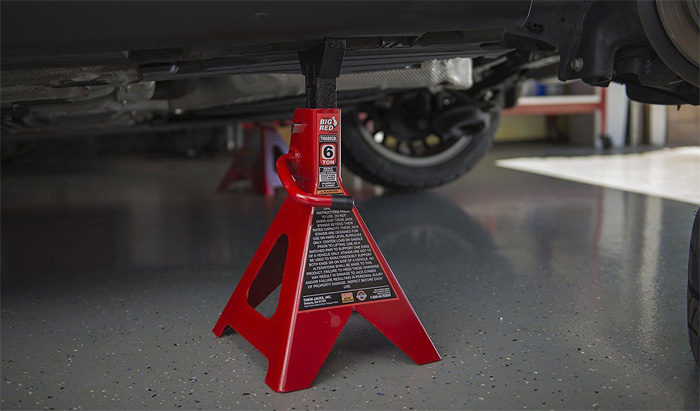
Neither a bottle jack nor a floor jack should serve as the sole support for a vehicle while anyone works beneath it. Both types are lift tools — not sustained support devices. Jack stands are the non-negotiable safety layer that converts a raised vehicle into a safe working position. Once the vehicle reaches the correct working height, jack stands go under the designated support points before any person goes under the vehicle. This protocol applies whether the task takes ten minutes or three hours, and it applies to every vehicle regardless of size.
Our team recommends pairing any jack purchase with stands rated for at least the vehicle's gross weight. Full-size trucks and heavy SUVs can approach 7,000 to 9,000 pounds — light-duty stands rated for 2 tons per pair are not adequate for those applications. Matching stand capacity to vehicle weight is just as important as matching jack capacity.
Supporting Gear Every Mechanic Needs
Beyond stands, a few additional items make any lift session safer and more productive. Wheel chocks prevent rolling on any axle that isn't being raised — a basic precaution that eliminates one of the most common garage incidents. Rubber-padded saddle adapters protect factory pinch welds on vehicles where direct metal-to-metal contact would cause body damage. A quality valve cover gasket is worth having staged for any session involving engine bay access, so work doesn't stall mid-job over a missing part.
For anyone who also services motorcycles, the approach to lifting and support differs significantly from four-wheeled procedures. Knowing which side of the bike needs support during a swap — informed by factors like tire wear patterns on touring bikes — affects both jack positioning and stand placement in ways that are specific to two-wheeled platforms.
Real-World Scenarios: Choosing the Right Jack for the Job
Trucks, SUVs, and Off-Road Vehicles
This is where bottle jacks consistently earn their reputation. Lifted trucks and full-size SUVs often sit high enough that a standard floor jack operating near maximum extension can't reach the frame with adequate stability margins. A 4-ton or 6-ton bottle jack, positioned on a stable base at the correct jack point, handles these vehicles with room to spare. Our team uses bottle jacks routinely for differential fluid changes, driveshaft removal, and transfer case work on high-clearance trucks — applications where the combination of reach and compact profile makes the bottle jack the only practical choice available in a standard home garage.
For trucks running performance upgrades — including spark plugs optimized for fuel efficiency or aftermarket suspension lifts — work under the vehicle becomes more involved, and having the right lift setup in place before the job starts is what separates an efficient session from an unnecessarily complicated one.
Low-Clearance Cars and Daily Drivers
For daily drivers, sports cars, and sedans with low-profile tire setups, a floor jack is almost always the correct starting point. The low minimum height of a quality floor jack — particularly a sport-style unit with a sub-3-inch entry point — allows it to slide under vehicles where even the collapsed height of a standard bottle jack blocks access entirely. Our team keeps a dedicated low-profile floor jack specifically for this category of work, and we reach for it far more often than any other lifting tool in the rotation.

The stability advantage of a floor jack is especially noticeable on front-wheel-drive platforms, where weight distribution shifts significantly once a wheel is removed. A floor jack's wide chassis absorbs that change without drama. A bottle jack in the same position requires careful rebalancing of the entire support setup. For standard garage maintenance on passenger vehicles, the floor jack's ease of use and inherent stability make it the practical choice across the widest range of common tasks.
Frequently Asked Questions
What is the main difference between a bottle jack and a floor jack?
The primary differences are form factor and application range. Bottle jacks are compact, vertical cylinders with high weight capacity and a taller minimum lift height — suited for high-clearance vehicles and confined spaces. Floor jacks sit low and wide on a rolling chassis that offers greater stability and a lower entry height, making them better suited for most passenger cars and standard garage work surfaces.
Can a bottle jack be used on a standard passenger car?
In most cases, no. The majority of standard passenger cars and low-riding sedans sit too close to the ground for a bottle jack to fit beneath them in the collapsed position. Low-profile floor jacks are the practical solution for these vehicles. Bottle jacks work well on higher-riding vehicles like trucks, vans, and lifted SUVs where the minimum height requirement isn't a barrier.
Is a bottle jack or floor jack better for trucks?
Bottle jacks are generally more practical for lifted trucks and large SUVs due to their taller height range and higher weight capacities. Floor jacks can struggle to reach the frame of elevated vehicles when operating near maximum extension, which reduces stability significantly. Most serious truck owners keep a high-capacity bottle jack on hand specifically for this reason.
How much weight can a standard floor jack lift?
Most consumer-grade floor jacks are rated between 1.5 and 3.5 tons. Professional-grade models reach 5 tons or more. Bottle jacks are available in substantially higher ratings — 6, 12, and 20-ton models are widely available — which is one reason they're favored for commercial vehicles and heavy equipment applications where floor jack capacity falls short.
Is it safe to work under a vehicle supported only by a hydraulic jack?
No. Neither bottle jacks nor floor jacks should be the sole support for a vehicle while anyone is working beneath it. Both are lifting tools, not sustained support devices. Jack stands rated for the vehicle's weight are required before any person goes under a raised vehicle. Hydraulic seals can fail without warning, and no jack — regardless of type or capacity — is a substitute for proper jack stands.
What capacity floor jack does a home garage need?
A 2-ton floor jack handles most passenger cars and small SUVs without issue. A 3-ton model covers a broader range including mid-size SUVs and light trucks. Our team recommends a 3-ton floor jack for any home garage that services more than one vehicle type, since the added capacity headroom comes with minimal size or cost penalty and covers nearly every common application.
Can bottle jacks and floor jacks be used safely outdoors?
Both can be used outdoors on firm, level surfaces. Concrete is ideal. Asphalt can deform under the concentrated point load of a bottle jack base in warm weather. Gravel and soil require a hardwood board or dedicated jack pad placed beneath the base of either type. The floor jack's wider footprint distributes weight more effectively on outdoor surfaces compared to a bottle jack's narrow base, making it slightly more forgiving in imperfect outdoor conditions.
How often should hydraulic jacks be inspected or serviced?
Our team recommends a basic inspection every six months for any jack in regular use — checking for fluid weeping around the ram seals, testing the release valve for smooth operation, and confirming that the saddle and base plate show no cracking or deformation. Any jack that drifts under load, meaning a raised vehicle sinks without the valve being opened, should be serviced or replaced before it is used again.
The right jack for the job isn't the one sitting in the corner of the garage by default — it's the one that matches the vehicle's height, the work surface, and exactly what the task demands.


About Chris Lewis
Chris Lewis developed a deep knowledge of automotive filtration, maintenance, and repair through years of hands-on experience working on vehicles — a passion rooted in time spent in his father's San Francisco auto shop from an early age. He has practical familiarity with air, oil, fuel, and cabin filter systems across a wide range of vehicle makes and models, along with experience evaluating the tools and equipment that serious DIY mechanics rely on. At MicrogreenFilter, he covers automotive and motorcycle filter reviews, maintenance guides, and automotive tool recommendations.
Get FREE Filters now. Or latest free tools from our best collections.
Disable Ad block to get all the secrets. Once done, hit any button below