microGreen Spin-On Oil Filter: Advanced Dual-Element Filtration Explained
by Chris Lewis
Studies show that up to 60 percent of engine wear occurs during cold-start conditions — before pressurized oil reaches critical bearing surfaces and cylinder walls. The microgreen dual element oil filter addresses that vulnerability directly by combining a full-flow primary element with a bypass secondary element inside a single spin-on canister. Drivers committed to genuine engine protection within the broader automotive maintenance discipline have increasingly turned to dual-element filtration as a meaningful upgrade beyond what conventional single-stage filters deliver.
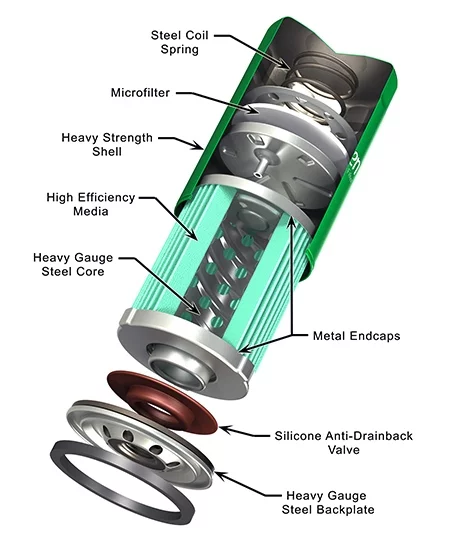
Standard spin-on oil filters capture particles down to roughly 20–25 microns — a threshold large enough to pass the fine metallic debris and carbon soot responsible for cumulative bearing and cylinder wall wear. The microGreen bypass stage targets contaminants as small as 3 microns, intercepting what conventional full-flow-only designs consistently allow to circulate. According to Wikipedia's overview of oil filter technology, bypass filtration has long been recognized as superior for fine-particle removal, yet most production vehicles still rely on full-flow-only canister designs.
Understanding how the two elements operate in concert, recognizing genuine strengths and real limitations, selecting proper installation tools, and avoiding the errors that compromise the system — these form the complete picture of what the microGreen filter demands from an informed user.
Contents
How the Dual-Element System Actually Works
The microGreen filter's defining characteristic is its two-stage architecture — a design that keeps full oil flow unrestricted while simultaneously routing a portion of total flow through a finer bypass element. The canister profile is slightly larger than a standard spin-on filter, a direct result of housing two distinct filtration media inside one unit without adding external plumbing or supplemental mounting hardware.
Full-Flow Primary Stage
The primary element handles the bulk of oil volume at normal engine operating pressure, maintaining flow rates within OEM design parameters:
- Filtration threshold of 20–25 microns — consistent with OEM specifications
- Captures large metallic particles, dirt, and carbon deposits before they reach bearings
- Includes a bypass relief valve that opens if the element becomes restricted during cold starts
- Compatible with conventional, synthetic blend, and full synthetic motor oils
Bypass Secondary Stage
The bypass element processes roughly 10 percent of total oil volume per pass — a small fraction that cycles through repeatedly across a full drain interval, achieving cumulative fine filtration that full-flow designs cannot replicate:
- Targets particles down to 3 microns — significantly finer than OEM element thresholds
- Removes oxidation byproducts, microscopic metallic shavings, and combustion soot
- Operates at reduced pressure, protecting the fine media from high-pressure surges
- Progressively improves oil cleanliness throughout the entire service interval
Filtration Specifications Compared
| Specification | Full-Flow Primary Element | Bypass Secondary Element |
|---|---|---|
| Filtration Threshold | 20–25 microns | 3 microns |
| Oil Volume Processed | ~90% of total flow | ~10% per pass |
| Operating Pressure | Full engine oil pressure | Reduced bypass pressure |
| Primary Function | High-volume coarse filtration | Fine-particle progressive removal |
| Bypass Relief Valve | Yes — opens at restriction | Not required |
| Replacement Schedule | Every oil change | Same canister — replaced together |
Measurable Strengths and Honest Trade-Offs
The microgreen dual element oil filter delivers quantifiable protection advantages that justify the higher acquisition cost, particularly for high-mileage engines, turbocharged applications, and any vehicle operating under sustained high-load conditions.
What the Filter Does Better
- Superior fine-particle removal — 3-micron bypass filtration intercepts contaminants that cause progressive bearing fatigue across tens of thousands of miles
- Cleaner oil throughout the drain interval — bypass action maintains lower particle counts from the first mile after a change to the last
- Reduced cumulative cold-start wear — cleaner oil with lower viscosity-resistance circulates to critical surfaces faster than contaminated oil
- Extended drain interval compatibility — when paired with full synthetic oil and confirmed by oil analysis, longer intervals become defensible
- Robust anti-drainback valve prevents dry starts in applications where the filter mounts horizontally or inverted
Drivers who already follow disciplined service schedules — the approach detailed in guides covering how often to change a fuel filter and what the job actually involves — find that dual-element filtration integrates naturally into an existing maintenance-first mindset.
Where Expectations Need Adjusting
- Unit cost runs 3–5× that of a standard spin-on filter — the value proposition is cumulative, not immediate
- Larger canister dimensions can create clearance issues on closely packaged engine bays; confirm fitment before purchasing
- A single filter change produces no immediate noticeable difference — benefits accumulate across multiple service intervals
- Not a substitute for correct oil viscosity selection, worn-seal repair, or an overdue valve cover reseal
Pro insight: Users who run oil analysis consistently report lower metallic particle counts at equivalent drain intervals when using dual-element filtration — the bypass element's cumulative effect shows up clearly in the data, even when it remains invisible under the hood.

Tools and Supplies for a Clean Installation
A microGreen filter installation requires the same basic toolkit as any oil service, with a few additional considerations tied to the filter's canister dimensions and its extended-service design philosophy. Multi-vehicle owners — particularly those managing both cars and motorcycles, as examined in comparisons of car oil vs. motorcycle oil formulations — should confirm application fitment separately for each platform before ordering.
What the Job Requires
- Cap-style filter socket — microGreen canisters commonly require a 65mm or 67mm cap socket; confirm sizing via the manufacturer's fitment guide
- Torque wrench for drain plug reinstallation — tightening to specification prevents both leaks and stripped threads
- Drain pan with at least 8-quart capacity for most passenger vehicle applications
- Lint-free rags for cleaning the filter seating surface on the engine block
- Fresh oil in the vehicle manufacturer's specified viscosity — do not select viscosity based on filter brand claims alone
- Oil analysis kit (optional but strongly recommended for interval optimization with synthetic oil)
Step-by-Step Installation Sequence
- Warm the engine 3–5 minutes to thin oil and suspend particles toward the drain point
- Raise and secure the vehicle on rated jack stands — hydraulic floor jacks alone are not a safe work platform
- Remove the drain plug and allow full drainage before touching the filter — partial drainage leaves particles suspended in retained oil
- Clean the engine block mounting surface thoroughly with a lint-free rag
- Apply a thin film of fresh oil to the new filter's gasket — skipping this step is the single most common installation error
- Thread the filter on by hand until the gasket contacts the seating surface, then add exactly three-quarter turn by hand
- Reinstall the drain plug with a new crush washer, torqued to the vehicle manufacturer's specification
- Fill with fresh oil, start the engine, and confirm the oil pressure warning light extinguishes within 10 seconds
- Inspect both the drain plug and filter base for seepage before lowering the vehicle

Oil Filtration Myths the Industry Keeps Repeating
Persistent misconceptions about bypass filtration lead some drivers to overestimate what a filter alone can accomplish and others to undervalue the technology entirely. Accurate expectations protect both the engine and the investment.
Myth: The Filter Eliminates Oil Change Necessity
The bypass element removes solid particles — it does not address chemical degradation, fuel dilution, water contamination, or depleted additive packages that accumulate in oil regardless of filtration quality. Filtration and oil changes solve different problems and must coexist in any sound maintenance program:
- Motor oil oxidizes chemically at operating temperature regardless of particle cleanliness
- Drain intervals should be determined by oil analysis data or OEM guidelines — not filter marketing claims
- Dual-element filtration supports extended intervals with synthetic oil when analysis confirms safe contamination levels; it does not justify indefinite service
Myth: Lower Micron Rating Always Means Better Filtration
A full-flow element rated at 3 microns would restrict oil delivery dangerously at any operating temperature — the bypass architecture exists precisely to resolve this constraint. The microgreen dual element oil filter achieves fine filtration without compromising total oil delivery to bearings and moving surfaces:
- A 3-micron full-flow element would starve bearings of lubrication during cold starts and high-demand acceleration
- ISO 4548-12 efficiency ratings provide a more complete performance picture than raw micron numbers alone
- OEM specifications define minimum acceptable filtration for each engine — the microGreen exceeds those thresholds without violating flow requirements
- Filter construction quality, anti-drainback valve reliability, and media collapse resistance matter as much as micron rating in real-world performance
Installation Errors That Undermine Performance
Drivers switching to the microgreen dual element oil filter sometimes negate the system's advantages through installation oversights that would compromise any filter. The consequences range from slow seepage leaks to catastrophic oil loss within the first drive cycle.
The Most Damaging Installation Mistakes
- Double-gasketing — failing to remove the old filter's gasket before installation creates a stacked seal that blows out under pressure, producing instant oil loss and potential engine damage
- Over-tightening with a wrench — exceeding hand-tight plus three-quarter turn deforms the gasket permanently and makes future removal destructive to the mounting threads
- Under-filling oil after the change — the microGreen canister holds slightly more volume than a standard filter; always verify with the dipstick before starting
- Reusing the drain plug crush washer — a deformed washer creates a slow drip that can mask filter-area leaks and leads to gradual oil level loss
- Skipping the lubricated-gasket step — a dry gasket seats unevenly under pressure and may produce seepage that appears intermittent before worsening
Owners who apply systematic attention across all fluid systems — the discipline described in detail by resources covering how a fuel filter works and why condition matters — bring exactly the right mindset to a microGreen installation. Precision during the installation phase is what converts a quality component into actual engine protection.
Matching Oil Type to Filtration Capability
- Full synthetic oil flows faster at low temperatures, delivering higher bypass element throughput during cold starts when fine-particle capture matters most
- Conventional and synthetic blend oils remain compatible but limit bypass throughput at temperatures below 40°F
- Avoid mixing viscosity grades across drain intervals — inconsistent flow dynamics reduce bypass efficiency and complicate oil analysis interpretation
- Oil analysis every 5,000–7,500 miles provides the data required to confidently extend synthetic drain intervals beyond OEM defaults
Frequently Asked Questions
What makes the microGreen dual element oil filter different from a standard spin-on filter?
The microGreen houses two separate filtration elements — a full-flow primary element for high-volume coarse filtration at 20–25 microns, and a bypass secondary element targeting particles as fine as 3 microns. Standard spin-on filters use only a single full-flow element, leaving fine contaminants circulating through the engine throughout the service interval.
Does the bypass element reduce engine oil pressure?
No — the bypass element processes only a small percentage of total oil volume at reduced pressure, leaving the full-flow primary stage to maintain normal engine oil pressure across all operating conditions, including high-RPM and cold-start scenarios.
How often should the microGreen filter be replaced?
MicroGreen recommends replacing the filter at every oil change. Unlike remote bypass units with separate extended-replacement schedules, this spin-on design integrates both elements in one canister, making the service interval identical to the oil drain interval — whether standard or extended with synthetic oil.
Can the microGreen dual element oil filter be used with conventional motor oil?
Yes — the filter is compatible with conventional, synthetic blend, and full synthetic motor oils. Full synthetic maximizes bypass element throughput at cold temperatures and supports data-validated extended drain intervals, but conventional oil remains fully compatible for standard service schedules.
Will the filter create clearance problems on a compact engine bay?
The microGreen canister is slightly larger than a standard OEM-equivalent spin-on filter due to its dual-element housing. On most vehicles clearance is not an issue, but on tightly packaged transverse-mounted engines, physical fitment should be confirmed against the manufacturer's application guide before purchase.
Does dual-element filtration allow longer oil drain intervals?
Dual-element filtration supports extended intervals when full synthetic oil is used and oil analysis confirms acceptable contamination and additive depletion levels. The filter removes particles but does not halt chemical oil degradation — drain intervals must be validated through analysis, not assumed based on filter capability alone.
What is the correct installation torque specification for the filter?
The installation specification is hand-tight until the lubricated gasket contacts the seating surface, followed by an additional three-quarter turn by hand — no wrench needed for the filter itself. The drain plug should be torqued to the vehicle manufacturer's specification using a calibrated torque wrench with a new crush washer installed.
Are there common signs that an oil filter — any brand — is failing between changes?
Dropping oil pressure on the gauge or warning light, visible oil seepage at the filter base, a burning oil smell from the engine bay, or a dark oil level loss without visible external leaks are the primary indicators. Any of these symptoms warrants immediate inspection before the next scheduled service interval.
A filter that captures what conventional designs miss does not change what oil is — it changes how clean that oil remains between every change, and clean oil is the foundation every engine depends on to survive.


About Chris Lewis
Chris Lewis developed a deep knowledge of automotive filtration, maintenance, and repair through years of hands-on experience working on vehicles — a passion rooted in time spent in his father's San Francisco auto shop from an early age. He has practical familiarity with air, oil, fuel, and cabin filter systems across a wide range of vehicle makes and models, along with experience evaluating the tools and equipment that serious DIY mechanics rely on. At MicrogreenFilter, he covers automotive and motorcycle filter reviews, maintenance guides, and automotive tool recommendations.
Get FREE Filters now. Or latest free tools from our best collections.
Disable Ad block to get all the secrets. Once done, hit any button below