When your car door won't open from inside, the fix is almost always one of four things: a broken interior handle, a disconnected actuator rod, a faulty latch assembly, or a child safety lock that's been accidentally activated. Most of these are manageable repairs you can handle yourself with basic tools and an afternoon. This guide covers every major cause, a clear diagnostic path, and step-by-step repair instructions, so you know exactly what you're dealing with before spending a dime. For more guides like this, browse the full automotive section.

A door that won't open from the inside is more than frustrating — it's a genuine safety hazard. In an emergency, every exit matters. Whether you're stuck in a parking lot or you noticed the problem pulling into your driveway, addressing this promptly and correctly is the right call.
The root causes span a wide range: from purely mechanical issues you can see and feel to electrical failures hiding behind the door panel. This guide walks you through each scenario systematically, from the simplest checks to more involved repairs, so you can invest your time and money in the right solution.
Contents
- Understanding Why a Car Door Won't Open From Inside
- Diagnosing the Root Cause of Your Stuck Door
- Quick Fixes to Try Before Anything Else
- Step-by-Step: How to Replace an Interior Door Handle
- Tools You'll Need for Interior Door Repairs
- Best Practices to Keep Your Door Latches Working
- Real Scenarios: What Different Symptoms Tell You
- When to DIY and When to See a Mechanic
- What to Expect: Repair Cost Breakdown
- Frequently Asked Questions
Understanding Why a Car Door Won't Open From Inside
To fix the problem, you need to understand how the door mechanism works in the first place. The interior handle connects to the latch assembly through a series of metal rods and plastic retaining clips. When you pull the handle, it tugs on those rods, releasing the latch and allowing the door to swing open. When any piece of that chain fails, the door stays shut — even if the handle itself moves freely.
The Basic Mechanics of an Interior Door Latch
According to Wikipedia's overview of door handles, automotive interior handles operate on a lever-and-rod system. The key components in that chain are:
- Interior door handle — the lever you pull to initiate the release sequence
- Actuator rods — thin metal rods connecting the handle to the latch
- Retaining clips — plastic clips that hold rods onto their pivot points
- Latch assembly — the spring-loaded mechanism that grips and releases the door striker
- Lock linkage — connects the lock button to the latch to prevent opening when locked
- Child safety lock — a separate mechanical switch on the door edge that disables the interior handle entirely
Each of these can fail independently. The good news is that most failures are obvious once you remove the door panel and take a direct look.
Common Failure Points
Not all failures are equal in terms of effort or cost. Some are quick fixes you can solve in minutes; others require parts and patience. Here are the most frequent causes, roughly in order of how often they appear:
- Broken plastic retaining clip on an actuator rod — extremely common on vehicles with more than 75,000 miles
- Interior handle cracking or snapping — plastic degrades over time, especially in temperature extremes
- Latch assembly seizing due to corrosion or dried-out lubrication
- Child safety lock engaged accidentally — often after a car wash, valet, or shop visit
- Power lock actuator failure on vehicles with central locking
- Rod slipping off its clip without breaking — often after a door panel removal that didn't fully reseat the clip
Diagnosing the Root Cause of Your Stuck Door
Before you reach for any tools, take a few minutes on a systematic diagnosis. A clear picture of what's actually failing saves you from buying parts you don't need and doing work that won't solve anything.
Starting With the Obvious
Run through these checks in order before pulling any trim:
- Check the child safety lock. Open the door from outside. Look at the interior edge of the door near the latch. There's a small lever or slider typically labeled "Lock/Unlock" or marked with a child icon. If it's in the locked position, flip it to unlocked and test the interior handle.
- Verify the door isn't simply locked. Some older vehicles and certain door designs won't open from inside while the manual lock is engaged. Unlock the door manually and try the handle again.
- Try the handle with slow, firm, steady pressure. A partially disconnected rod sometimes responds to a deliberate pull rather than a quick yank. Don't force it, but test with consistent tension.
- Listen for a click at the latch. If you hear or feel the latch releasing but the door still won't open, the issue is the latch-to-striker interface — not the handle or rod. That's a different repair path.
Narrowing It Down Further
If those quick checks don't identify the problem, you need to look inside the door cavity. Here's a concise diagnostic framework based on how the failure presents:
- Handle pulls freely but nothing engages → rod disconnected or retaining clip broken
- Handle is stiff or won't move at all → handle assembly is cracked, seized, or completely broken
- Lock button moves but doesn't change the door's behavior → lock linkage failure
- Works intermittently → loose clip or slightly bent rod that catches sometimes and slips other times
- Power lock doesn't respond + interior handle doesn't work → start with the door lock fuse before opening anything
Intermittent problems are often the trickiest. If your door fails occasionally rather than consistently, try to catch it failing before you start disassembly — knowing exactly what's loose or binding in its failed state is far more useful than examining it when it's temporarily working.

Quick Fixes to Try Before Anything Else
Some of the most common causes of a stuck interior door handle have solutions that cost nothing and take under five minutes. Try these before committing to a full door panel removal.
The Child Safety Lock Check
This is the single most overlooked cause of a door that won't open from inside. Child safety locks are designed to prevent rear-door passengers from opening doors while the vehicle is moving. They get bumped accidentally far more often than you'd expect — particularly after a car wash, a valet, or recent service work on the door.
To check and reset it:
- Open the door using the exterior handle
- Locate the small lever on the inside edge of the door, near the latch — often labeled or marked with a lock icon
- Toggle it to the Unlock or Off position
- Close the door and test the interior handle
If that was the issue, you're done. No parts, no tools, no cost whatsoever.
Lubricating the Latch and Rods
A stiff or intermittently failing latch is often a lubrication problem. Corrosion and dried-out grease cause latch pawls and actuator rods to bind rather than move freely. The right lubricant applied directly to the mechanism can restore full function in minutes.
What to use:
- White lithium grease — best overall choice for latch mechanisms and metal pivot points; clings well and resists moisture
- Dry PTFE spray — good for rods and clips where you don't want a wet, sticky residue
- Silicone spray — works in a pinch but breaks down faster than lithium grease under repeated use
Avoid using standard WD-40 as a primary lubricant. It's a water displacer, not a long-term lubricant — it will evaporate and potentially leave the mechanism drier than before within weeks.
To apply: use a narrow straw attachment to direct the lubricant into the latch from the door edge gap. Work the handle several times to distribute it through the mechanism. Wipe off any excess to avoid drips onto interior trim.
Step-by-Step: How to Replace an Interior Door Handle
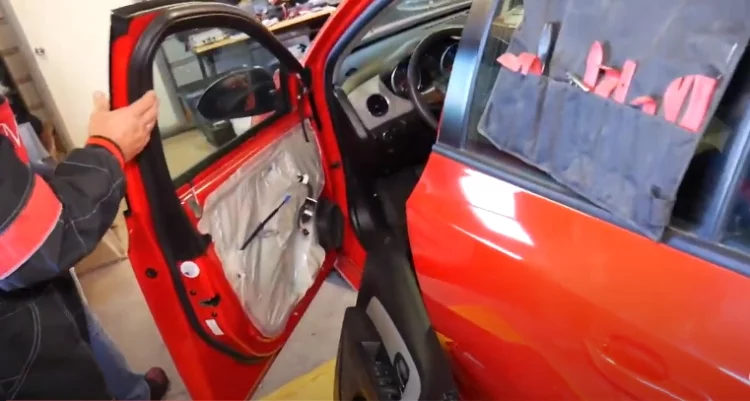
If the handle itself is physically broken or the actuator rod needs a hands-on reconnection, you'll need to remove the door panel. This sounds more involved than it is. Most vehicles follow the same basic procedure, and the entire job is manageable with patience and the right tools.
Removing the Door Panel
- Disconnect the negative battery terminal. Any time you're working near door electrical components — windows, locks, mirrors — this precaution takes 30 seconds and prevents shorts.
- Locate and remove all visible screws. Check inside the door pull cup, behind the handle bezel, and in the armrest. Many screws are hidden under small plastic caps — pop them off with a trim tool or flathead.
- Release the panel clips around the perimeter. Use a plastic trim removal tool to work around the bottom and sides of the panel, popping the push-in clips from their holes one by one. Start at a lower corner and work methodically. Rushing this step breaks clips and can crack the panel face.
- Lift the panel straight up. Most door panels hook over the top edge of the door frame. Once all clips are free, lift upward to unhook it — don't pull straight out first.
- Disconnect wiring connectors before fully removing the panel. Power window switches, lock buttons, and mirror controls all have connectors you need to unplug. Squeeze the release tab and pull each connector straight out.
- Set the panel face-up on a soft surface to avoid scratching the interior finish.

Disconnecting and Replacing the Handle
- Identify the handle mounting bolts or screws. These are typically 2–3 fasteners accessible from inside the door cavity once the panel is off.
- Photograph the rod connections before disconnecting anything. A quick phone photo saves significant time during reassembly.
- Disconnect the actuator rod(s). Each rod connects to the handle via a small retaining clip. Use a small flathead screwdriver to pop the clip off the handle lever. Note the orientation before removing.
- Remove the old handle. Back the mounting screws out, then slide or pull the handle assembly free from the door skin.
- Install the new handle. Align it with the mounting holes and thread all screws in by hand before tightening. Don't overtighten — you're usually threading into plastic or thin aluminum, which strips easily.
- Reconnect the actuator rod. Snap the retaining clip back fully onto the handle lever. A partially seated clip is exactly what causes intermittent failures — make sure it's fully engaged.
- Test before reinstalling the panel. Reconnect the battery terminal, hold the door gently closed, and pull the interior handle. Confirm the latch releases cleanly and fully. Only reinstall the door panel after you've confirmed everything functions correctly.
The exact panel clip locations and handle mounting points vary by make and model. Pulling up a vehicle-specific video for your exact year and door before you start is always worth the few extra minutes.
Tools You'll Need for Interior Door Repairs
Having the right tools before you start prevents frustration, avoids broken trim, and keeps the job moving efficiently. Most of what you need is probably already in your garage.
Basic Hand Tools
- Plastic trim removal tool set — non-negotiable for popping panel clips without cracking plastic or leaving pry marks
- Phillips and flathead screwdrivers — for handle screws and latch rod clips
- Socket set with 8mm, 10mm, and 12mm sockets — the most common sizes for door hardware across most vehicles
- Needle-nose pliers — essential for reaching into tight spaces to manage small clips and rods
- Flashlight or hands-free headlamp — door cavities are dark and cramped; good lighting is not optional
Specialty Items That Help
- Door panel clip replacement kit — factory clips break on removal more often than not. Having a pack of replacements means your panel won't rattle afterward
- Magnetic parts tray — small screws fall into door cavities instantly and are nearly impossible to retrieve without one
- White lithium grease with narrow straw applicator — for lubricating the latch while you have everything accessible
- Zip ties — for tying wiring harnesses back into their original routing so they don't contact moving parts
If you're doing multiple repairs around the vehicle at the same time and need to raise it for undercarriage access, having the right jack matters. Take a look at this comparison of bottle jacks vs floor jacks to see which setup suits your workspace and vehicle weight best.
| Tool | Purpose | Estimated Cost | Priority Level |
|---|---|---|---|
| Plastic trim removal set | Remove door panel without cracking clips or trim | $8–$20 | Essential |
| Phillips / flathead screwdrivers | Handle screws and latch rod clips | Already owned | Essential |
| Socket set (8–12mm) | Handle mounting bolts | $15–$40 | Essential |
| Needle-nose pliers | Rod clips in tight spaces | $8–$15 | Essential |
| Flashlight or headlamp | Visibility inside door cavity | $10–$25 | Essential |
| White lithium grease | Latch and pivot point lubrication | $5–$12 | Recommended |
| Door panel clip replacement kit | Replace broken factory clips on reassembly | $6–$15 | Recommended |
| Magnetic parts tray | Prevent lost screws in door cavity | $5–$12 | Optional |

Best Practices to Keep Your Door Latches Working
Prevention is always cheaper than repair. A few simple habits will keep your door latches and handles working reliably for the life of the vehicle and significantly reduce the chances of getting stuck with a door that won't cooperate.
Regular Lubrication Schedule
Latch mechanisms face temperature extremes, moisture, and road grime. Without periodic lubrication, they corrode and eventually seize. Here's a practical schedule to follow:
- Every 12 months or 15,000 miles: apply white lithium grease to each latch assembly and door hinge
- Every 6 months if you live in a high-humidity or coastal area — salt air accelerates metal corrosion significantly
- Any time a door handle starts feeling stiffer than usual — don't wait for it to fail completely before lubricating
- After any deep cleaning or pressure washing of the vehicle — water at pressure flushes out existing lubricant from gaps you can't easily see
You don't need to remove the door panel for routine maintenance lubrication. On most vehicles, you can access the latch from the door edge gap using a narrow straw attachment on a grease aerosol can.
Visual Inspections
Catching a problem early is almost always easier than dealing with a complete failure at an inconvenient moment. Work these quick checks into your routine:
- During oil changes, test every door from the inside — all four doors, including rear doors your passengers use
- Notice any change in how much force a handle requires. A gradually stiffer handle is telling you something
- Check door panel integrity periodically. A loose or rattling panel means clips are failing. Loose clips can snag actuator rods and cause the exact failure you're trying to prevent
- After any bodywork or door panel removal by a shop, always test the interior handle before you drive away from the lot
Many interior handle failures occur within a short time after someone else has worked on the door. Make it a habit to verify door function any time the trim has been disturbed — whether by you or a shop.
Real Scenarios: What Different Symptoms Tell You
The same end result — a car door won't open from inside — can have very different underlying causes depending on exactly how it fails. Your specific symptoms are the most useful diagnostic data you have, so pay close attention to the details before you start disassembling anything.
The Handle Moves But Nothing Happens
This is the most common pattern. The handle pulls and returns normally, but the latch doesn't release. The likely causes, in order of probability:
- Actuator rod disconnected — the retaining clip popped off and the rod is sitting loose inside the door cavity, completely detached from the handle lever
- Broken actuator rod — the metal rod itself snapped, typically near a bend or a connection point where stress concentrates
- Seized latch assembly — the latch mechanism won't release regardless of what input it receives
- Child safety lock engaged — mechanically interrupts the rod-to-latch connection at the door edge
If you pull the panel and find a loose rod dangling inside the door, reconnecting it is a five-minute job with no parts required. Confirm the retaining clip fully seats on the lever before putting everything back together.
The Handle Is Completely Stiff or Broken Off
If the handle doesn't move at all, or if pieces of it come away in your hand, the handle assembly itself has failed. This is particularly common on vehicles over eight to ten years old, especially in climates with extreme seasonal temperature swings that accelerate plastic brittleness.
In this situation, your approach changes slightly:
- Order a replacement handle before removing the panel — confirm the part number matches your specific year, make, model, and which door (driver vs. passenger, front vs. rear)
- Some handles are sold as a standalone lever; others come as a full bezel-and-handle assembly. Know which one your vehicle uses before ordering
- Budget for a clip replacement kit at the same time — you'll need it
- If the handle broke due to impact or abuse rather than age, inspect the surrounding door panel for cracks that might affect the repair
Electrical issues can sometimes mimic or compound mechanical handle failures. If your power locks also stopped responding around the same time the interior handle failed, a single wiring fault may be affecting multiple systems — similar to how brake lights can work while tail lights don't, where two functions share a circuit but fail independently due to one underlying problem.

When to DIY and When to See a Mechanic
Not every door problem deserves a shop visit, and not every one should be tackled solo either. Here's a straightforward breakdown of each side of that line so you can make a confident call.
Repairs You Can Handle Yourself
These are solid DIY territory for anyone with basic mechanical confidence and a couple of hours:
- Resetting the child safety lock — zero tools, zero cost, under two minutes
- Reattaching a disconnected actuator rod — once the panel is off, this is typically a five-minute job
- Lubricating the latch mechanism — usually no panel removal required at all
- Replacing a broken interior handle — one to two hours, moderate difficulty, significant savings over shop rates
- Replacing broken door panel clips during a panel removal job — straightforward and inexpensive
The main requirements: work methodically, don't force anything, and confirm each step before moving to the next. Patience matters more than mechanical expertise for most of these repairs.
When to Hand It Over
Some situations genuinely warrant professional attention:
- The door was damaged in a collision. Body damage bends the door structure itself, which affects latch geometry in ways you can't fix by swapping components. A body shop assessment is needed first.
- The latch assembly needs replacement and you're not comfortable with the full panel removal and reassembly process on your specific vehicle
- The problem involves the power lock actuator on a newer vehicle with complex body control module integration — some modern systems require scan tool programming after actuator replacement
- Multiple door systems are failing simultaneously — handle, lock, and window — which often points to a wiring harness issue rather than individual component failures
- You've completed the repair and the door still won't open, or now won't close and latch properly
Knowing when to stop and hand the job over is as valuable as knowing how to start it. A bent door frame or a misadjusted latch handled incorrectly can quickly become a more expensive and complicated problem than it was originally.
What to Expect: Repair Cost Breakdown
One of the main benefits of diagnosing a car door that won't open from inside is understanding the real cost before any money changes hands. The range here is wide — from literally nothing to several hundred dollars depending on what's actually broken.
DIY Parts Costs
If you're doing the work yourself, here's what parts will typically run you:
- Child lock reset: $0
- Actuator rod reconnection — retaining clip only: $3–$8 for a bag of replacement clips
- Latch lubrication: $5–$12 for a can of white lithium grease
- Interior door handle replacement: $15–$60 for the part, depending on make, model, and whether it's OEM or aftermarket
- Latch assembly replacement: $25–$90 for the part
- Power lock actuator replacement: $30–$100 depending on vehicle
Professional Labor Rates
When a shop does the work, labor adds substantially to these numbers. The table below shows realistic cost ranges for each repair type:
| Repair Type | DIY Parts Cost | Shop Labor (est.) | Total at Shop |
|---|---|---|---|
| Child lock reset | $0 | $0–$30 (diagnostic fee) | $0–$30 |
| Actuator rod reconnection | $3–$8 | $50–$100 | $55–$110 |
| Interior handle replacement | $15–$60 | $75–$150 | $100–$220 |
| Latch assembly replacement | $25–$90 | $100–$200 | $130–$300 |
| Power lock actuator replacement | $30–$100 | $100–$200 | $140–$320 |
| Collision-related latch repair | Varies | $200–$600+ | $250–$700+ |
The DIY-versus-shop gap is most dramatic for an interior handle replacement. You can do it yourself for $15–$60 in parts, compared to $100–$220 at a shop. For most drivers with a free afternoon, that savings is well worth the time invested.
Keep in mind that labor rates vary by region, and newer vehicles or luxury models with integrated door electronics can push costs well above the ranges listed here. Always get a written estimate before authorizing any door-related work at a shop.
Frequently Asked Questions
Why does my car door open from outside but not inside?
This almost always indicates a problem with the interior handle linkage rather than the latch itself. Since the exterior handle is releasing the latch successfully, the latch is functional — the connection between the interior handle and the latch is what's broken, disconnected, or blocked. Start by checking the child safety lock on the door edge. If that's not it, pull the door panel and inspect the actuator rod and its retaining clip for disconnection or breakage.
How do I know if the child safety lock is activated?
Open the door using the exterior handle and look at the inside edge of the door near the latch. You'll see a small lever or slider, usually labeled with a padlock icon or the words "Lock/Unlock." If it's in the locked position, toggle it to the unlocked position, close the door, and test the interior handle. If the door now opens normally, the child safety lock was your only problem.
Is it safe to drive the car when the door won't open from inside?
It's technically possible to drive, but it creates a genuine safety risk. In an accident or emergency, you need every exit available. If you must drive before the repair is done, make sure any occupant in that seat knows to exit through a different door, and keep the window operational as a backup. Treat it as a short-term workaround only — not an acceptable ongoing condition.
How expensive is it to replace an interior door handle?
For most vehicles, this is one of the more affordable door repairs. Parts typically run $15–$60 depending on the vehicle. If you do the work yourself, that's your entire cost. A shop will add $75–$150 in labor, bringing the total to roughly $100–$220. Even at the higher end, it's not a major expense compared to many other automotive repairs.
How long does an interior door handle replacement take?
Most people complete this job in one to two hours the first time through. If you've done it before, or if your vehicle has a straightforward door panel design, you can often finish in under an hour. The door panel removal — specifically releasing all the clips without breaking them — is typically the most time-consuming step. Having all your tools laid out before you start makes a real difference.
What's the best lubricant for a car door latch?
White lithium grease is the best general-purpose choice. It adheres well to metal, resists moisture and temperature extremes, and holds up over time. Dry PTFE spray is a solid alternative for rods and areas where you want a residue-free finish. Avoid using standard WD-40 as your primary lubricant — it's designed as a water displacer and will dry out within weeks, leaving your latch in the same condition or worse.
Can I fix a stuck door latch without removing the door panel?
Sometimes, yes. If a stiff or mildly corroded latch is the problem, you may be able to work lubricant into the mechanism through the door edge gap using a narrow spray straw, without removing any trim. However, a disconnected actuator rod, a broken handle, or a physically damaged latch will require panel removal to access and repair. When in doubt, pulling the panel also lets you confirm exactly what's wrong before spending money on parts.
What should I do if the door still won't open after trying these fixes?
If you've verified the child lock is off, confirmed the actuator rod is properly connected, and lubricated the latch — and the door still won't open from inside — the latch assembly itself is the likely culprit. It may be seized, damaged, or have a broken internal component. At that point, the latch needs replacement. If the door can still be opened from the outside, secure it before driving and schedule the latch replacement promptly.
Most car door failures come down to a single disconnected rod or a forgotten child lock — diagnose before you spend, and you'll almost always find the fix costs far less than you feared.


About Chris Lewis
Chris Lewis developed a deep knowledge of automotive filtration, maintenance, and repair through years of hands-on experience working on vehicles — a passion rooted in time spent in his father's San Francisco auto shop from an early age. He has practical familiarity with air, oil, fuel, and cabin filter systems across a wide range of vehicle makes and models, along with experience evaluating the tools and equipment that serious DIY mechanics rely on. At MicrogreenFilter, he covers automotive and motorcycle filter reviews, maintenance guides, and automotive tool recommendations.
Get FREE Filters now. Or latest free tools from our best collections.
Disable Ad block to get all the secrets. Once done, hit any button below